When the Dance Loses Its Meaning: How TikTok Turns Global Protest Into Content
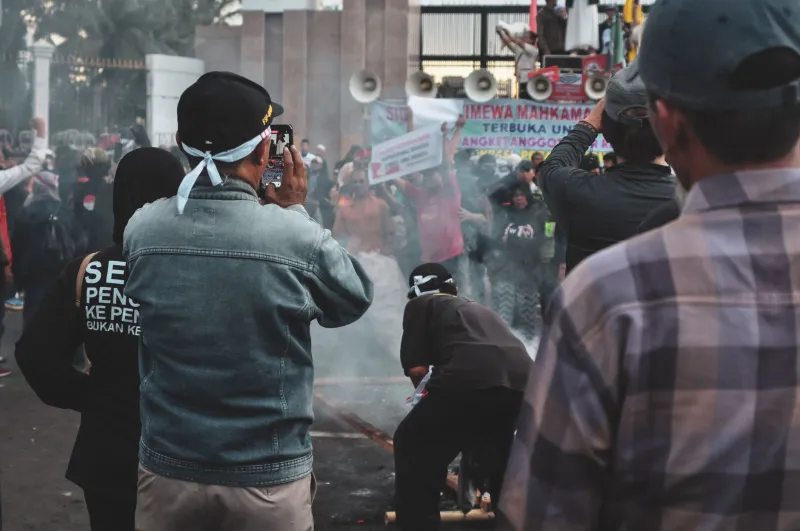
Let's start with a scene. It's 2022, and somewhere in Iran, a young woman cuts her hair in public. She's not performing. She's not doing it for likes. She's doing it because women in her country are being killed for how they wear their hair, and this is the only form of defiance available to her in that moment. The image circulates. The movement grows. And then — inevitably — it reaches TikTok, where it becomes an "aesthetic," a sound, a trend, a filter.
Something is gained. Awareness spreads. American teenagers who'd never thought about Iranian politics for a single second suddenly know the name Mahsa Amini. That matters.
Something is also lost. The cut hair becomes a vibe. The protest becomes a prompt. The algorithm does what algorithms do — it optimizes for engagement, not meaning — and by the time a dance or a gesture travels from a street in Tehran to a bedroom in Ohio, it's been processed into something that fits cleanly into a For You Page.
This is the central tension of our digital moment, and it's playing out across music and movement in ways that deserve more than a hot take.
The Protest That Became a Playlist
Music has always been political. What's new is the speed at which political music gets depoliticized. In the past, a protest song might take years to cross borders, and by the time it did, its context usually traveled with it. Bob Dylan's songs arrived in the UK with their civil rights DNA intact. The political dimensions of reggae were part of what made it globally compelling.
TikTok collapses that journey into hours. A song used at a protest in Hong Kong can be trending in Houston by the next morning — stripped of its context, repurposed as a background track for someone's coffee routine, its original charge completely invisible to the new audience encountering it.
This isn't entirely TikTok's fault. It's how platforms work. They're built to surface content that generates engagement, and political context often gets in the way of that. A dance is more shareable than an explanation. A sound is more viral than its backstory.
But the cumulative effect is worth examining.
Hong Kong's Protest Anthems and What Happened Next
During the 2019-2020 Hong Kong protests, music became a genuine tool of resistance. "Glory to Hong Kong" emerged as a kind of unofficial anthem, written collaboratively and performed in shopping malls and subway stations as acts of collective defiance. The song was specific — its lyrics referenced real political demands, real fears, a real moment in history.
Clips of those performances circulated globally, including on American social media. For a brief window, the song carried its meaning with it. But as the political urgency faded from Western news cycles, what remained in the algorithm wasn't the politics. It was the sound, the aesthetic of collective singing, the visual of crowds moving together. Those elements got absorbed into a general vibe of "powerful group moment" that could be attached to almost anything.
The song didn't disappear. But its specificity did.
Palestine, Pop, and the Problem of the Trend
More recently, Palestinian cultural expression has become a flashpoint for exactly this dynamic. Traditional Palestinian music, dabke dance, and protest songs have circulated widely on TikTok — sometimes with full political context, sometimes stripped of it entirely. The results have been genuinely mixed.
On one hand, millions of young Americans have encountered Palestinian culture in ways they never would have through traditional media. That's not nothing. Cultural visibility has political value. When people feel connected to a culture, they're more likely to care about what happens to it.
On the other hand, dabke — a traditional line dance with deep communal roots — has been recreated as a TikTok trend by people who have no connection to Palestine and no awareness of its significance. The dance gets divorced from the community that created it, flattened into choreography, and rated on how clean the execution is. The political and human context becomes optional background information rather than the whole point.
Is that appropriation? Is it appreciation? Is it just what happens when cultures move at internet speed? Probably all three, simultaneously, in different proportions depending on who's doing the dancing.
What the Algorithm Wants vs. What the Movement Needs
Here's the structural problem: protest movements need sustained attention. They need people to stay engaged past the initial viral moment, to understand context, to take action. Algorithms are optimized for exactly the opposite — novelty, turnover, the next thing. A protest song that trends for 72 hours and then gets replaced by a dog video hasn't necessarily served the movement that produced it.
American audiences, in particular, have a complicated relationship with this. The US has its own history of consuming Black and brown cultural expression — including protest expression — as entertainment while remaining disconnected from the political realities that produced it. TikTok hasn't created that tendency. It's just given it a faster engine.
The counterargument — and it's a real one — is that even partial awareness is better than none. The teenager who learned about Iranian women's rights through a TikTok trend might go on to actually read about it. The person who got curious about Palestinian dabke might follow that curiosity somewhere meaningful. The algorithm might be the door, even if it's not the destination.
The Music Itself Deserves Better
What often gets overlooked in these conversations is that the music and movement at the center of these trends is genuinely extraordinary. The protest songs coming out of Iran, Palestine, and Hong Kong are some of the most emotionally powerful music being made anywhere in the world right now, precisely because the stakes for the people making it are so high.
That music deserves an audience. It deserves to be heard. The question is whether the way it's being distributed — through an entertainment platform built for maximum engagement — is the right vessel for what it's carrying.
There's no clean answer. But there is a responsibility, for creators and consumers alike, to at least ask the question before hitting share.